 지산열린학원지산고2 · 25년 10월 · 40번
📌 제시의 요지
인간은 시간을 고정된 것으로 보고 자연의 시간에 맞추려 조정하지만, 자연은 인간의 시간관에 굴복하지 않는다.
Humans see time as fixed and keep adjusting it to fit nature, but nature does not yield to the human view of time.
🌊 정미의 문단 흐름
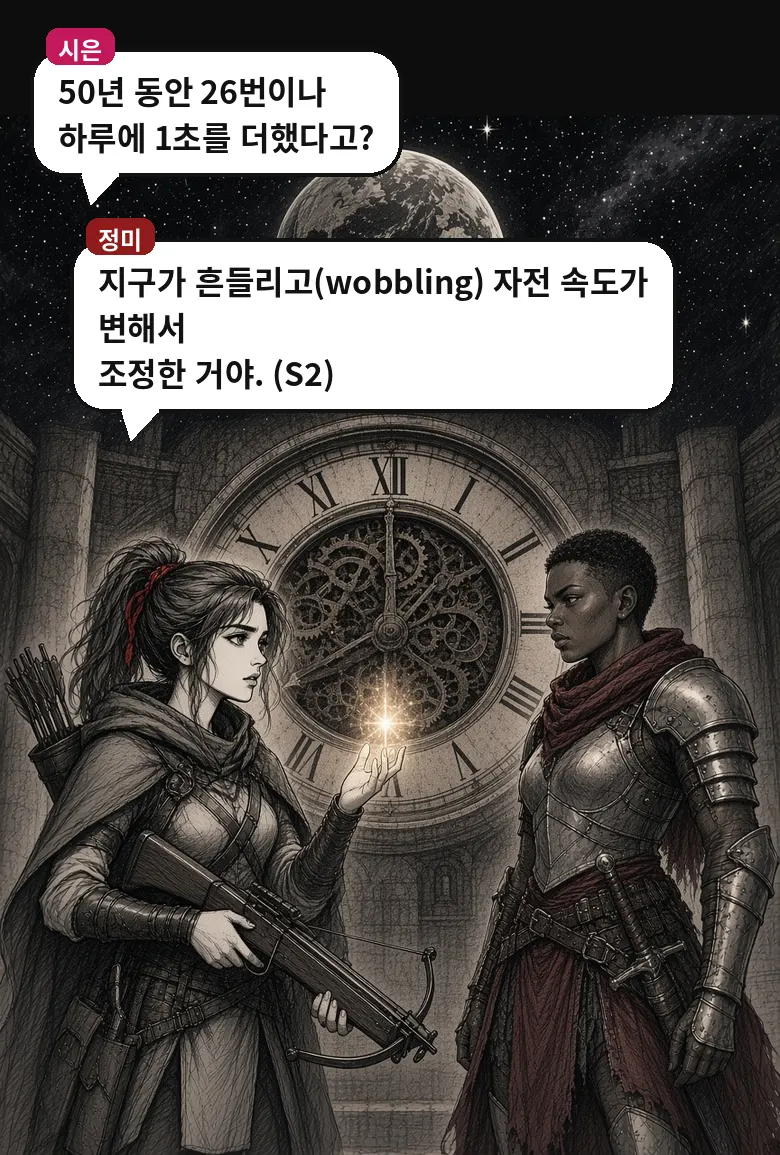
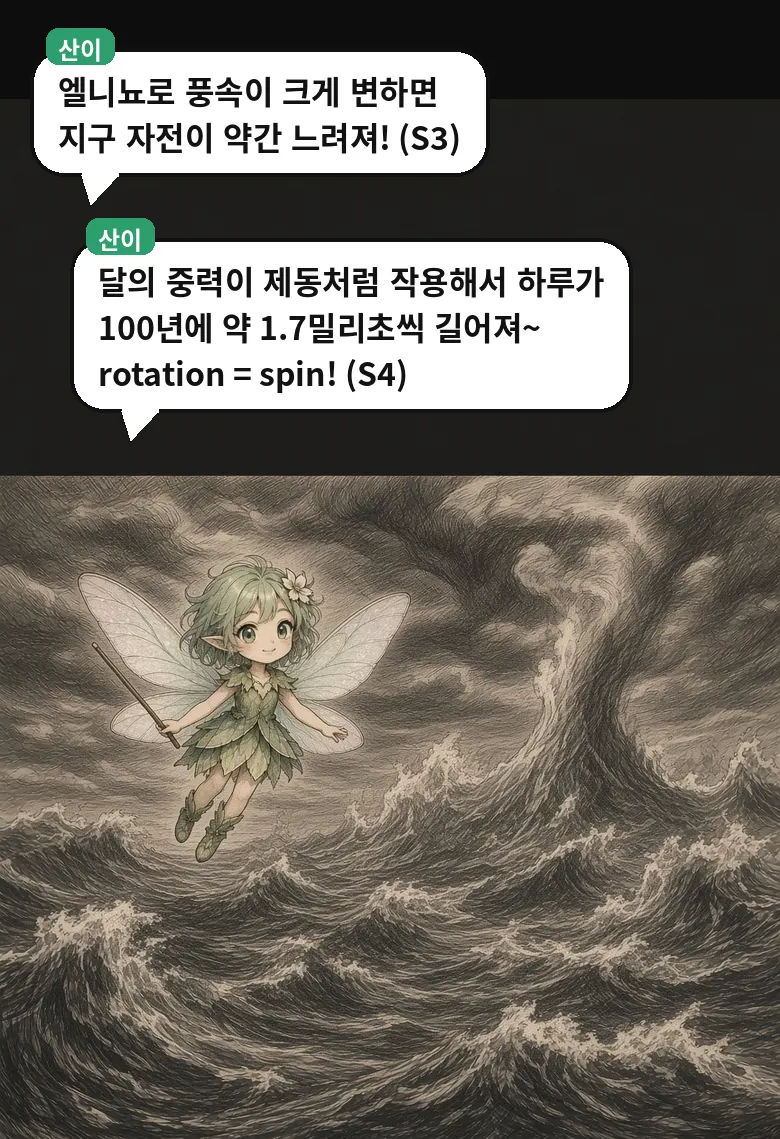
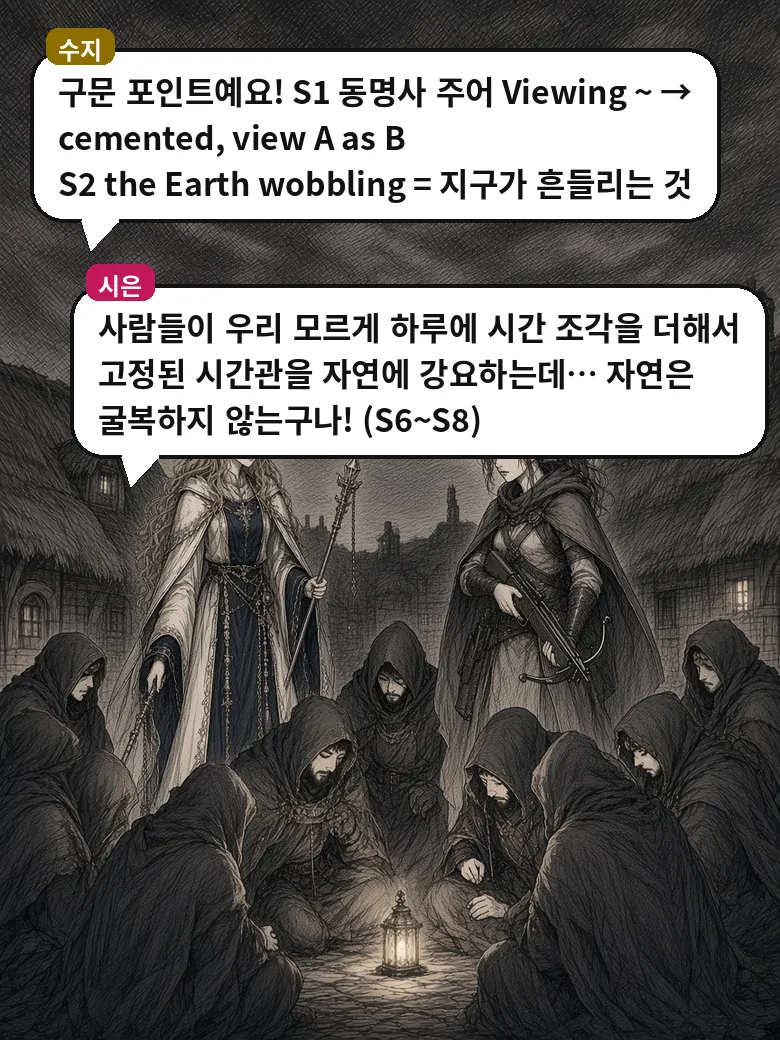
도입: 시간을 구매 가능하고 일정한 상품으로 보는 인위적 관점 — 때때로 그 실수를 인정해야 한다. (S1) / 전개: 50년간 26번 1초 추가(지구 흔들림·자전 속도 변화) / 엘니뇨 → 자전 약간 감속, 달의 중력 → 100년에 1.7밀리초씩 하루가 길어짐 → 인간의 시간과 자연의 시간이 어긋남. (S2~S5) / 결론: 몰래 시간 조각을 더하며 고정된 시간관을 자연에 강요하지만, 자연은 굴복하지 않는다. (S6~S8)
☠ 수남의 하수인: 시간 상인 리치


🧚 산이의 어휘
| 단어 | 뜻 | 동의어 / 반의어 |
|---|---|---|
| purchasable | 구매할 수 있는 | — |
| consistent | 일관된, 지속적인 | = constant ↔ variable |
| cement | 굳히다 | = solidify |
| artificial | 인위적인 | = man-made ↔ natural |
| psyche | 정신, 마음 | = mind |
| acknowledge | 인정하다 | = admit ↔ deny |

📖 본문 보기
Viewing time as a purchasable and consistent product cemented artificial views on time into our psyche, but every now and again we are forced to acknowledge this mistake. On twenty-six occasions in the last fifty years, a second has been added to everyone’s day to adjust for the Earth wobbling and the rate of its spin changing. For instance, when El Niño, a climatic system in the Pacific, causes wind speed to change dramatically, it can slow the rotation of the Earth slightly. Indeed, the Earth’s spin is generally slowing because the moon’s gravity is acting as a drag, so days are getting longer by about 1.7 milliseconds per century. Such events disturb the similarity between man-made time and more flexible time based on the Earth’s naturally occurring rotation. When events like this happen, a bunch of humans make the decision to add a small slice of time to your day, without your knowledge. We try to force our fixed, man-made view of time on to nature in the false hope that it will yield. It doesn’t.
🏹 시은의 질문 · “한 문장으로 줄이면?”
We treat time as fixed and keep adding seconds to match the Earth, but nature never gives in to our view.
우리는 시간을 고정된 것으로 여기고 지구에 맞추려 초를 더하지만, 자연은 결코 우리 시간관에 굴복하지 않는다.
🎯 원래 시험 정답
40. 다음 글의 내용을 한 문장으로 요약하고자 한다. 빈칸 (A), (B)에 들어갈 말로 가장 적절한 것은? [3점]
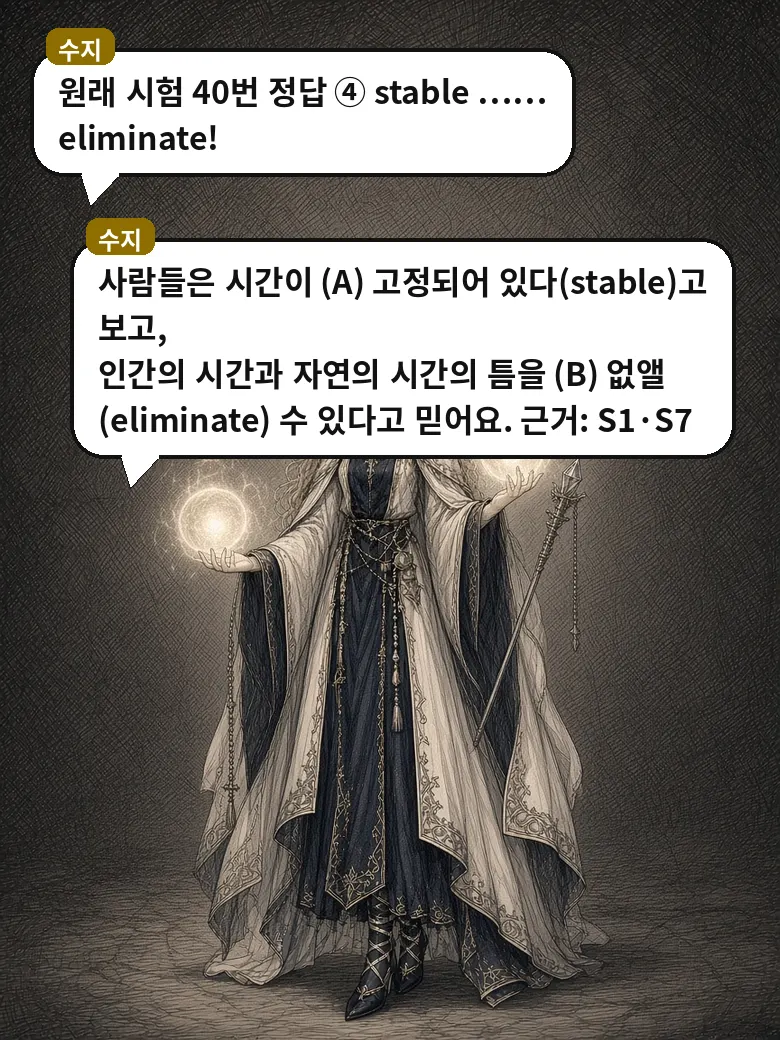
원래 시험 정답: ④ stable …… eliminate
📝 수지의 문제 풀이 (요약)
다음 글의 내용을 한 문장으로 요약하고자 한다. 빈칸 (A), (B)에 들어갈 말로 가장 적절한 것은? [3점]
Viewing time as a purchasable and consistent product cemented artificial views on time into our psyche, but every now and again we are forced to acknowledge this mistake. On twenty-six occasions in the last fifty years, a second has been added to everyone’s day to adjust for the Earth wobbling and the rate of its spin changing. For instance, when El Niño, a climatic system in the Pacific, causes wind speed to change dramatically, it can slow the rotation of the Earth slightly. Indeed, the Earth’s spin is generally slowing because the moon’s gravity is acting as a drag, so days are getting longer by about 1.7 milliseconds per century. Such events disturb the similarity between man-made time and more flexible time based on the Earth’s naturally occurring rotation. When events like this happen, a bunch of humans make the decision to add a small slice of time to your day, without your knowledge. We try to force our fixed, man-made view of time on to nature in the false hope that it will yield. It doesn’t.
- ① variable …… cause
- ② stable …… highlight
- ③ variable …… maintain
- ④ stable …… eliminate
- ⑤ relative …… narrow
🗡️ 흑검 ET의 정답 보기
정답 ④ stable …… eliminate — 원래 시험 40번 정답 ④ stable …… eliminate! 사람들은 시간이 (A) 고정되어 있다(stable)고 보고, 인간의 시간과 자연의 시간의 틈을 (B) 없앨 (eliminate) 수 있다고 믿어요. 근거: S1·S7
⚔️ 강신용의 함정: The Earth’s spin is generally getting faster… 그럴까? getting faster가 함정이다. 지구 자전은 느려지고(slowing) 있다. (S4)
"The Earth's spin is generally getting faster." → 'getting faster'는 틀림 → 'slowing' (S4)