 지산열린학원24년 10월 · 29번
📌 제시의 요지
언어적 은유는 청중이 능동적으로 노력해야 이해되는 수동적인 것인 반면, 디지털 기술의 은유는 사용자의 의미 지평을 적극적으로 바꾸는 능동적인 것이다.
Linguistic metaphors are passive and need the audience’s effort, while digital metaphors actively reshape users’ meaning horizons.
🌊 수온의 문단 흐름
디지털 은유 ≠ 언어 은유 → 수동 vs 능동 → 첫눈에 분명
☠ 수남의 하수인: 은유 왜곡 유물 수호자
🧚 산이의 어휘
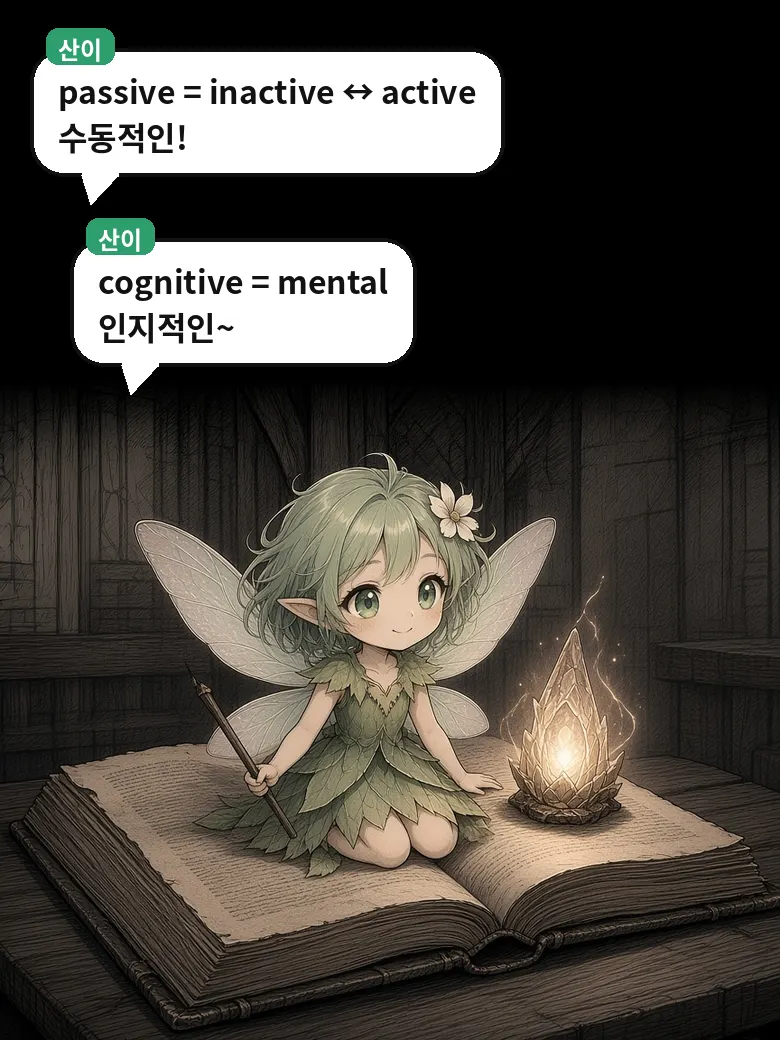
| 단어 | 뜻 | 동의어 / 반의어 |
|---|---|---|
| metaphor | 은유 | = figure of speech |
| passive | 수동적인 | ↔ active |
| cognitive | 인지의 | = mental |
| imposing | 강요하는, 위압적인 | = forceful |
| horizon | 지평, 범위 | = scope |
| at first glance | 한눈에 | = immediately |
📖 본문 보기
Digital technologies are essentially related to metaphors, but digital metaphors are different from linguistic ones in important ways. Linguistic metaphors are passive, in the sense that the audience needs to choose to actively enter the world proposed by metaphor. In the Shakespearean metaphor “time is a beggar,” the audience is unlikely to understand the metaphor without cognitive effort and without further engaging Shakespeare’s prose. Technological metaphors, on the other hand, are active (and often imposing) in the sense that they are realized in digital artifacts that are actively doing things, forcefully changing a user’s meaning horizon. Technological creators cannot generally afford to require their potential audience to wonder how the metaphor works; normally the selling point is that the usefulness of the technology is obvious at first glance. Shakespeare, on the other hand, is beloved in part because the meaning of his works is not immediately obvious and requires some thought on the part of the audience.
🏹 시은의 질문 · “한 문장으로 줄이면?”
Unlike passive linguistic metaphors, digital metaphors actively shape users and must be obvious at once.
수동적인 언어 은유와 달리, 디지털 은유는 사용자를 능동적으로 바꾸며 즉시 명확해야 한다.
🎯 원래 시험 정답
원래 시험 정답: ④ what → that
📝 수지의 문제 풀이 (어법)
다음 밑줄 친 부분 중, 어법상 틀린 것은?
Digital technologies are essentially related to metaphors, but digital metaphors are different from linguistic ①ones in important ways. … In the Shakespearean metaphor “time is a beggar,” the audience is unlikely to understand the metaphor without cognitive effort and without further ②engaging Shakespeare’s prose. Technological metaphors… are realized in digital artifacts that are actively doing things, forcefully ③changing a user’s meaning horizon. … normally the selling point is ④what the usefulness of the technology is obvious at first glance. Shakespeare… is beloved in part because the meaning of his works is not immediately obvious and ⑤requires some thought…
- ones
- engaging
- changing
- what
- requires
🗡️ 흑검 ET의 정답 보기
정답 ④ — 뒤에 주어(the usefulness)+동사(is)+보어가 갖춰진 완전한 절 → 보어 명사절 접속사 that. what은 불완전한 절을 이끈다.
⚔️ 강신용의 함정: ③ changing — ‘~하면서’를 뜻하는 분사구문이라 맞음.